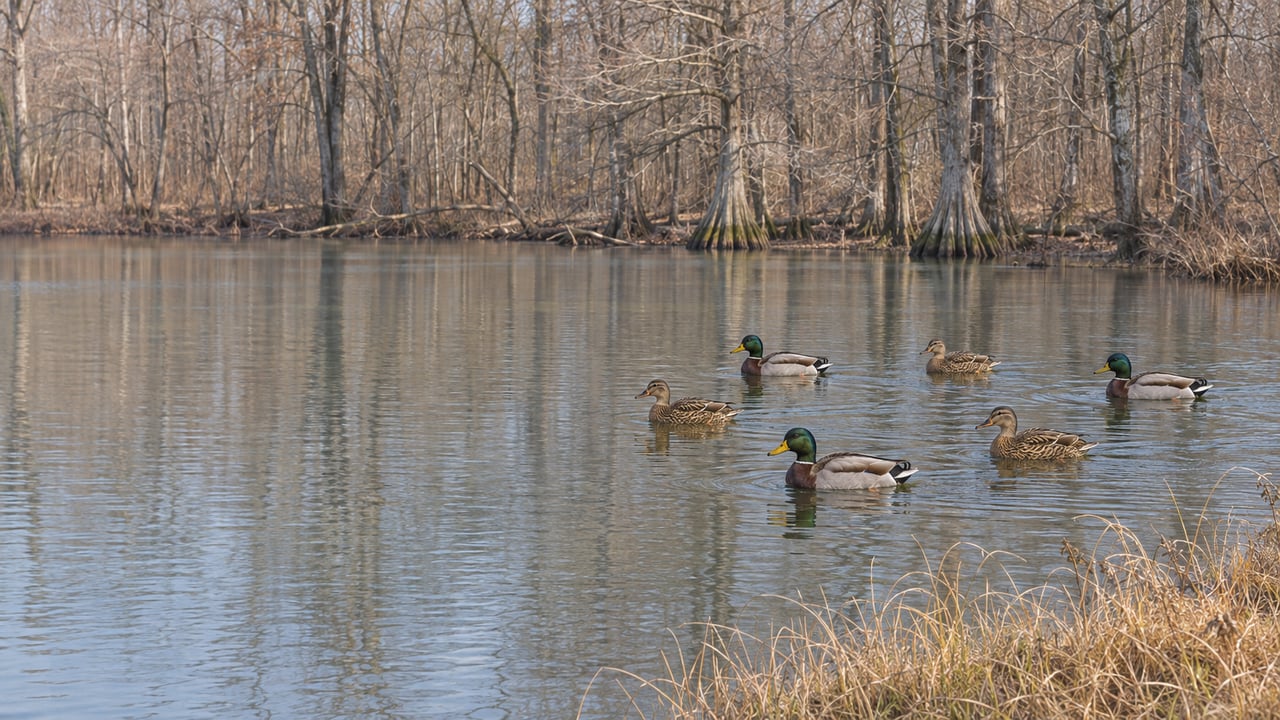
On Sunday, December 14, 2025, a single eBird checklist at Hovey Lake Fish & Wildlife Area recorded 2,200 Mallards, 550 Ring-necked Ducks, 250 Gadwall, 125 Canvasbacks, 90 Northern Pintails, 70 Lesser Scaup, 45 Hooded Mergansers and 18 Common Goldeneyes. Six weeks later, a January 23, 2026 checklist had just one each of Gadwall, American Wigeon, Mallard, Northern Pintail, Green-winged Teal and Ring-necked Duck. The same list counted 120 Snow Geese and 87 Greater White-fronted Geese.
That's how last winter went at Hovey. The ducks peaked in mid-December, and the geese kept building into late January. In an earlier winter, early February brought Sandhill Cranes. A December trip and a February trip to this stretch of floodplain south of Mount Vernon turn up different birds, and the dated counts from recent winters show roughly when each group arrived.
The place, briefly
Hovey Lake FWA is in the far southwest corner of Indiana, where the Ohio and Wabash river floodplains meet. It covers about 7,404 acres, including a 1,400-acre oxbow lake, smaller sloughs and marshes, and bottomland hardwood forest. Admission is free. According to the Indiana Birding Trail, the oxbow lakes, open marshes and cypress sloughs give Indiana birders "the feeling of being in the deep south while remaining in Indiana." The same page calls the property a critical migration stop for waterfowl in fall and winter.
The lake itself has been closed to boating, paddling and fishing since October 18, according to the property's 2026-27 waterfowl sheet. In winter, you watch the birds from land.
December is for ducks, and the first geese
Last season, the first big goose numbers came in early December. On December 6, 2025, one checklist recorded 70 Snow Geese, 50 Greater White-fronted Geese and three Tundra Swans. The same list had one Bald Eagle and 25 Rusty Blackbirds.
The big duck count from the opening paragraph came eight days later. Mallards made up most of it, alongside seven other duck species from Gadwall to Hooded Mergansers. Each checklist is a count from a single outing on a single day, so it shows what was there that day, not a monthly average.
January belongs to the geese and the blackbirds
By late January 2026, the geese had outlasted the ducks. The 120 Snow Geese and 87 Greater White-fronted Geese counted on January 23 were both higher than the December 6 numbers, while the ducks were down to single birds.
The steadiest bird of the winter was a small one. Checklists counted 20 Rusty Blackbirds on January 8, 20 on January 17 and 25 on January 23. The Indiana Birding Trail calls the Rusty Blackbird "a species in steep decline" and says it can be found at Hovey from winter through early spring.
Eagles showed up through the winter as well. The January 8 checklist recorded two Bald Eagles. The DNR says bald eagles can be seen at Hovey year-round. According to the Indiana Birding Trail, a pair nests in a snag every year, and the huge nest "is easily visible from land and can be watched and photographed from a distance without disturbing the birds."
February brings the cranes
The crane record comes from the winter before last. A February 2, 2025 checklist at Rail Marsh Bluff Trail recorded 26 Sandhill Cranes and eight Common Goldeneyes. The Indiana Birding Trail says late winter through spring are the most popular times to visit Hovey and suggests two to four hours of birding time.
Raptors are a good reason to stay the full time. The same page lists Northern Harrier, Red-shouldered Hawk, Cooper's Hawk, Sharp-shinned Hawk and American Kestrel among the raptors seen at Hovey through the year, and it says Barred Owls are common in the area.
The names on the checklists
Birders log their Hovey sightings under specific local names. Along with the main Hovey Lake FWA hotspot, eBird lists Base Road Cottonwood Slough, Rail Marsh Bluff Trail, Rail Marsh Levee Trail and Halfmoon Pond as hotspots on the property. One Base Road Cottonwood Slough checklist is dated February 21, 2026. The DNR hiking map marks an observation tower. The Indiana Birding Trail says mowed lanes, mowed levees and other trails across the property give good access for birding.
Before you go
Winter is waterfowl hunting season at Hovey too. The DNR's season listing has the South Zone duck season running November 28, 2026 through January 24, 2027. A DNR property map notes that some trails close during hunting seasons and asks visitors to call for current conditions. For a December or January trip, start with a phone call.
The office and visitors center is at 8401 State Road 69 South, Mount Vernon. It's open Monday, Tuesday and Thursday from 7 a.m. to 3 p.m. Central, and restrooms are available during office hours. Current visitor details are on the Hovey Lake FWA page.
The bald cypress will have to wait until after mid-February. The DNR describes the lake as "an excellent spot to explore by paddle while experiencing some of Indiana's only bald cypress trees up close," and the same property page lists it as closed to recreational paddling from late October until mid-February. For the rest of the year's outdoor calendar, see our guide to outdoor recreation and riverfront activities in Mount Vernon and our Mount Vernon neighborhood page.
At The Realty Collective, we think a winter morning at Hovey Lake is part of what makes Mount Vernon home. If you've been wondering what your own place near the river is worth this season, we're glad to prepare a free home valuation, and we'd love to hear what you spotted at Rail Marsh.